A lace veil or not?
Lace on a Veil — Romantic, Heirloom, or Overdone?
Lace on a veil is the embellishment with the most history behind it — and that history is exactly what makes it the most complicated to get right.
It's one of three embellishment options on the Veil Workshop vote, and I included it because it's genuinely one of the most requested. But it's also the one that divides people most. So here's my honest, fashion-designer-friend take.
What lace actually does to a veil
Every other embellishment adds something to the veil. Lace changes what the veil is.
A pearl scatter is the veil, decorated. A lace-edged veil is something different — more structured, more formal, more considered. The lace carries weight (visual weight, not actual weight) that plain tulle doesn't have on its own.
That's what makes it so powerful, and also what makes it tricky. A lace trim doesn't just add detail — it shifts the whole register of the veil toward something more traditional, more heritage, more bridal in the specific, formal sense of that word.
For some brides, that's exactly right. For others, it's too much in that direction.
The different ways lace appears on a veil
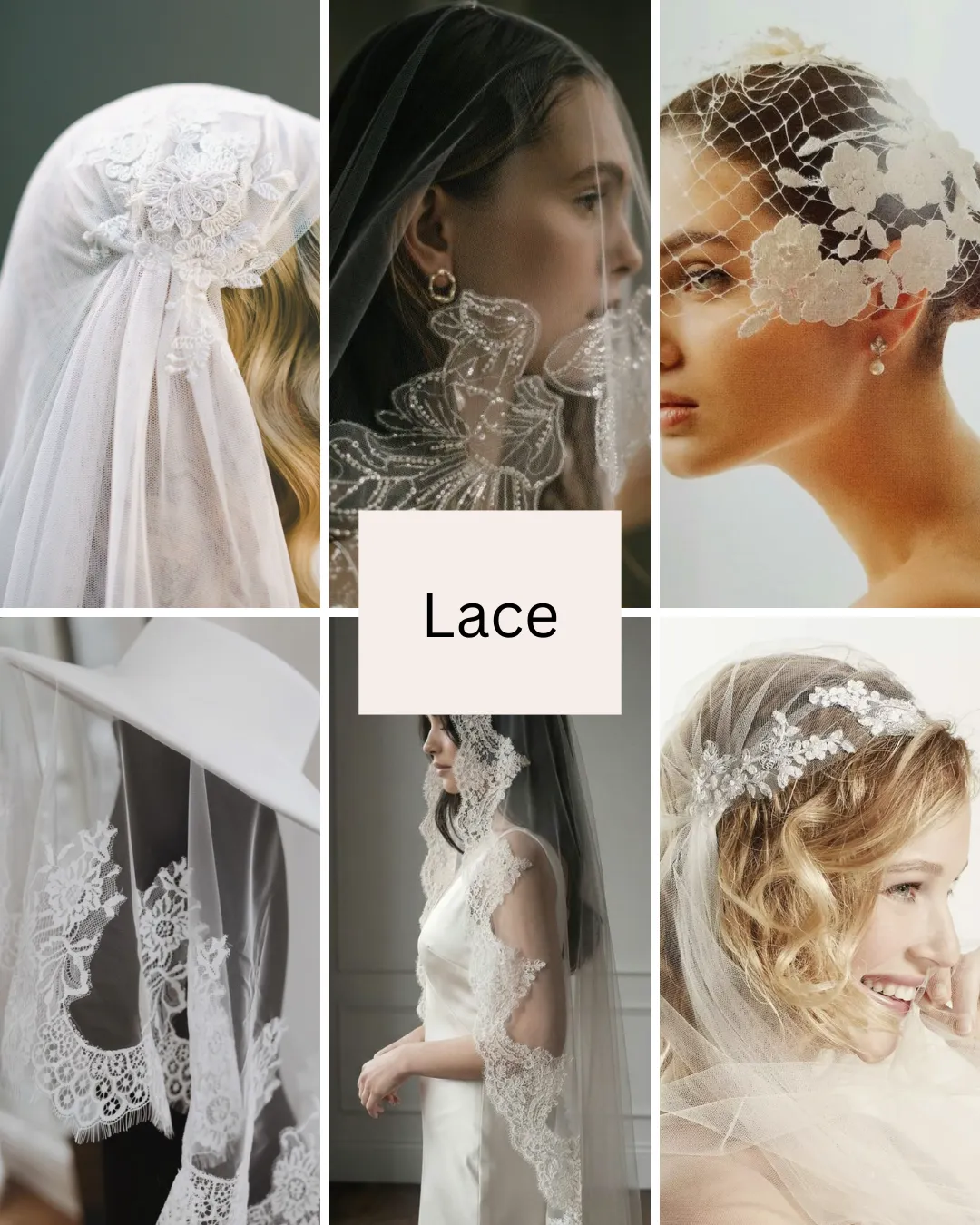
Lace edge trim A strip of lace running along the hem — the most common version. The width of the trim changes everything: a narrow trim is delicate and barely-there; a wide trim reads as a deliberate design choice.
Lace appliqué Individual lace motifs applied to the veil body rather than along the edge. More unusual, more intricate, and much more labour-intensive — but it gives you control over placement in a way edge trim doesn't.
A fully lace veil The entire veil made from lace fabric rather than tulle. This is the heirloom option — often used to repurpose or reference a family piece. It reads very differently from a tulle veil with lace trim.
Lace blusher layer Lace on just the face layer of a two-tier veil. The contrast between the lace blusher and the plain tulle beneath it is a lovely detail — and it means you get the lace moment without committing the whole veil to it.
When lace works — and when it doesn't
It works when:
Your dress has lace in it too, and you want the veil to reference that rather than compete with it
You want something that reads as genuinely considered and traditional
You're going for a romantic, heritage, pre-Raphaelite kind of feeling
The lace is high quality — cheap lace is always visible
It doesn't work when:
The lace pattern fights with the detail on your dress rather than complementing it
The scale is wrong — a large-scale lace pattern on a narrow trim looks like an afterthought
You've chosen it because it "looks bridal" without thinking through whether it's your kind of bridal
Making the decision
Lace can be the most delicate, barely-there thing on a veil — a narrow trim that catches light and disappears. Or it can be bold, even dramatic: a wide coloured lace that creates real impact trailing behind you down the aisle.
That's the thing about making it yourself. You choose the lace, the width, the colour, the placement. Nobody hands you a set option. You decide whether your lace whispers or announces itself — and that's a decision worth making deliberately, not leaving to whatever a supplier happens to stock.
Lace has earned its place on veils over centuries. But the brides I see happiest with a lace-trimmed veil are the ones who chose it because it was genuinely right for them — not because it felt like the safe, expected thing.
If your instinct is lace, trust it. If you're reaching for it because it seems like what a veil should look like, it's worth pausing.
If lace is the one you keep coming back to — or if you're torn between all three — that's exactly why I'm putting it to a vote for the next workshop. Cast your vote here and grab the free Pre-Veil Checklist while you're at it.